Types of Agricultural Adjuvants: The Complete Guide for Formulators in 2027
The Active Works, the Adjuvant Delivers
You can have the right pesticide, the right dose and the right timing and still get disappointing results. Sometimes the problem is how the spray reaches and interacts with the target.
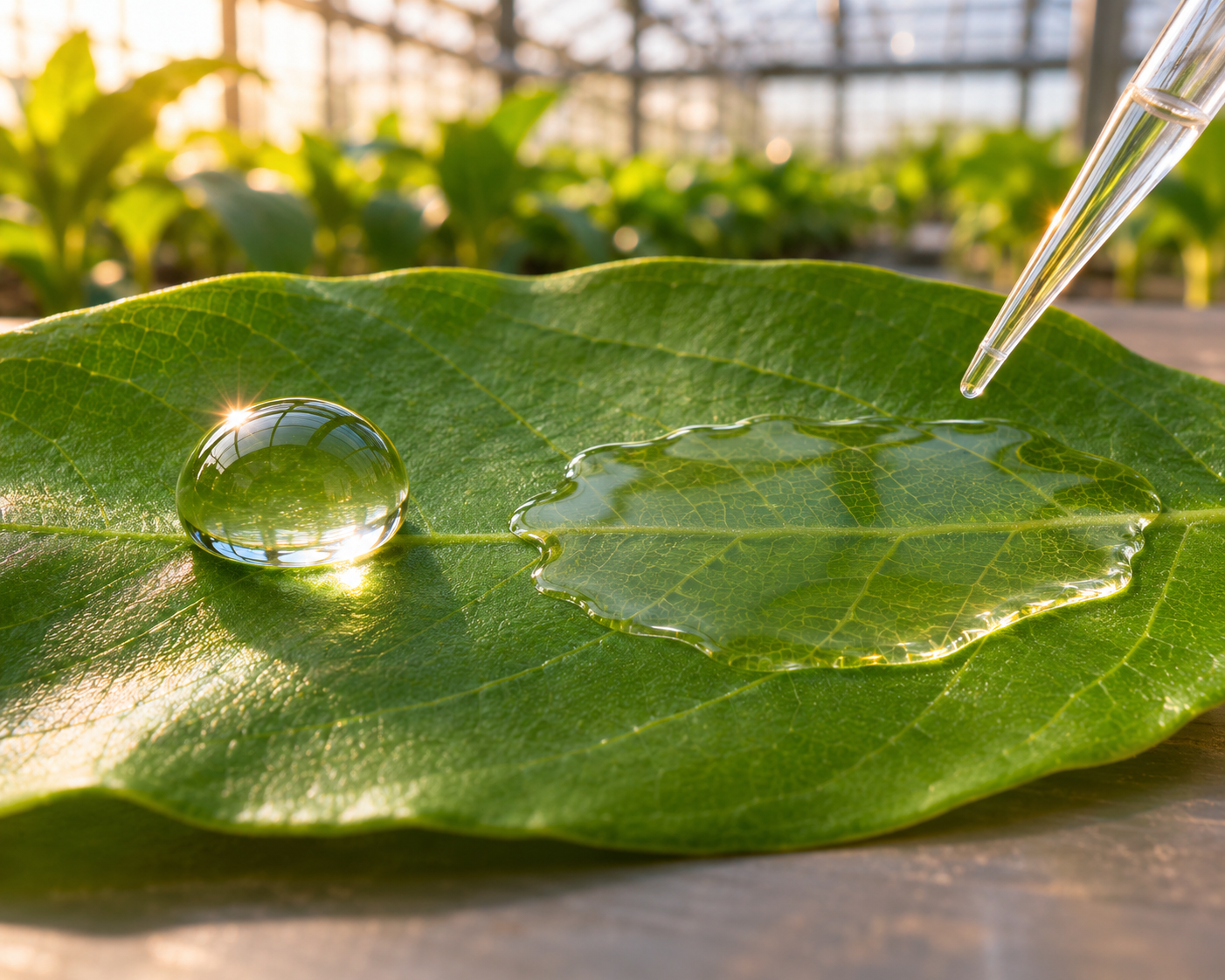
A droplet can bounce off a leaf, bead up on a waxy surface, drift away or dry before the active ingredient has enough time to work. This is where agricultural adjuvants earn their place. A well-chosen adjuvant helps create the conditions the active ingredient needs to perform. For formulators, choosing the right adjuvant starts with identifying where performance breaks down.
What Is an Agricultural Adjuvant?
An agricultural adjuvant is a material added to an agrochemical formulation or spray mixture to modify its application characteristics or performance. An in-formulation adjuvant is incorporated by the manufacturer. A tank-mix adjuvant is added to the spray mixture before application.
By function, spray adjuvants are commonly grouped into two categories:
- Activator adjuvants support pesticide performance by improving properties such as wetting, spreading or penetration.
- Utility adjuvants address practical spray problems such as drift, foam, hard water, pH or tank-mix compatibility.
These categories describe the primary job an adjuvant does. One product may serve several functions.
Activator Adjuvants: Making the Active Work Harder
Activator adjuvants help the spray interact more effectively with the target surface. Common types and functions include surfactants, wetting and spreading, penetration support and oil-based adjuvants.
Surfactants
Surfactants reduce surface tension, helping droplets wet a target surface where they might otherwise bead up. Organosilicone super spreaders can promote much greater spreading in suitable spray systems. Their performance depends on the formulation, use rate and target surface.
Wetting and Spreading Agents
Wetting agents improve contact between spray droplets and difficult-to-wet surfaces, such as waxy leaves. Spreading agents help droplets cover more of that surface. Some products combine wetting with other functions. Fenton Chemical’s Wetting Sticking Agent, for example, is designed to improve wetting and help the spray adhere to the treated surface.
Penetration Aids
Some adjuvants help an active ingredient move through the plant cuticle. Whether greater penetration is useful depends on the active ingredient, crop sensitivity, application rate and product label directions.
Oil-Based Adjuvants
Crop oil concentrates and methylated seed oils can improve wetting or help certain pesticides penetrate the target surface. Fenton Chemical’s Horticulture Spray Oil Adjuvant is an example of an oil-based product designed to support adhesion and penetration.
The best adjuvant for pesticides depends on the active ingredient and the problem being solved. A herbicide applied to waxy foliage may need a different adjuvant from an insecticide formulation that already wets the target well.
Utility Adjuvants: Fixing Spray Problems
Utility adjuvants address problems that can arise during mixing or application. Choose one based on the specific property you need to change.
Drift-Control Agents
Drift-control agents can reduce the proportion of fine droplets that are more likely to move off target. Their effect depends on the adjuvant, spray mixture and equipment. Nozzle selection and application conditions still matter.
Antifoam Agents
Antifoam agents help limit excessive foam during spray preparation and agitation, making the mixture easier to handle.
Water Conditioners
Dissolved minerals in hard water can interfere with the performance of certain pesticides. A suitable water conditioner can help address that interaction. The choice depends on the water source, active ingredient and label directions.
Buffers and Acidifiers
Acidifiers lower spray-solution pH, while buffers help resist pH changes. Follow any label directions on spray-solution pH for the products in the tank.
Compatibility Agents
Compatibility agents can help keep suitable tank-mix partners evenly dispersed. If a mixture separates, clumps or gels, check product directions and investigate the cause before using it.
How to Pick the Right Adjuvant for Your Formulation
Start with the problem you need to solve. Ask these five questions:
What’s the formulation type?
Emulsifiable concentrates (EC), suspension concentrates (SC), soluble concentrates (SL), wettable powders (WP) and water-dispersible granules (WG, also called WDG) have different requirements.
What needs to improve?
Identify whether the priority is wetting, penetration, foam control, physical compatibility, drift or water quality.
What’s the target surface?
A waxy leaf can behave differently from a hairy or easily wetted surface. Evaluate performance on the intended target.
How will the spray be applied?
Conventional ground spraying and low-volume drone spraying can have different coverage and deposition requirements. Evaluate the adjuvant with the intended spray equipment and volume.
What happens in the complete mixture?
For in-formulation use, test the adjuvant in the finished formulation for stability and application performance. For tank-mix use, follow the product labels and use a jar test to screen unfamiliar combinations for physical incompatibility with the intended water source and mix partners. Assess crop safety and efficacy separately.
Fenton Chemical is an Indian manufacturer of agrochemical adjuvants based in Indore. It offers formulation support for systems including EC, SC, SL and WDG. The company reports batch testing and an ISO 9001:2015-certified quality management system. Use supplier specifications to shortlist candidates, then use compatibility and application testing to select a grade.
Adjuvant Trends to Watch in 2027
Precision spraying and low-volume drone applications are giving formulators more reasons to evaluate droplet behaviour and coverage under the intended spray conditions. Spray volume and nozzle choice can affect both deposition and pest control.
Utility adjuvants remain relevant as formulators address water quality, drift and tank-mix compatibility. Bio-based adjuvants are another area to watch. Their environmental impact depends on the specific product and how it is used.
For formulators, the practical takeaway is to select and test an adjuvant for the intended formulation, target surface and application method.
Frequently Asked Questions:
What are the two main types of agricultural adjuvants?
By function, spray adjuvants are commonly grouped into activator and utility adjuvants. Activators support pesticide performance through functions such as wetting, spreading or penetration. Utility adjuvants address practical issues such as foam, drift, water quality and tank-mix compatibility.
Are surfactants and adjuvants the same?
A surfactant can act as an adjuvant by reducing surface tension and improving wetting or spreading. The broader adjuvant category also includes products such as antifoams, water conditioners and drift-control agents.
Which adjuvant is best for pesticides?
Choose an adjuvant based on the pesticide label, active ingredient, formulation type, crop surface, application method and the specific performance issue.
Do all formulations need a super spreader?
A super spreader is worth evaluating when coverage on a difficult-to-wet surface is a problem. The right choice depends on the formulation and intended application. For a closer look at how silicone adjuvants behave in different systems, see Fenton’s comparison of trisiloxane and polysiloxane adjuvants.
What should formulators ask an adjuvant supplier for?
Request the technical data sheet (TDS), safety data sheet (SDS), relevant specifications, recommended use level, a batch certificate of analysis and compatibility guidance. Test the proposed grade in the actual formulation or spray mixture before scaling up.
Bottom line: Identify the spray or formulation problem first, then verify that the selected adjuvant solves it under the conditions in which it will be used.
More Blogs
View All →
Can You Mix OSA with Fertilizers and Pesticides? A Practical Compatibility Guide
Is Your Super Spreader Fake? A Simple 5 minutes Lab Test to Check Quality

OSA for Sugarcane: Delivering Silicon for Stronger Stalks and Better Recovery

Is Your Super Spreader Burning the Crop? Signs of Overdose and Safe Limits

The Silicon Toolkit for Modern Crops: Where OSA and Spreaders Each Fit

Matte, Gloss, Durable: How Additives Shape Paint Performance

The Adjuvant Mistake That's Costing Farmers Every Spray Cycle